



Did you know over 500,000 new startups launch every month in the United States? This huge number shows how competitive the market is. Yet, many founders fail because they lack the right tools. I’ve learned that having must-have gear for small businesses is key to staying ahead.
Success doesn’t happen by chance. It takes planning and a solid foundation. I want to share my list of essential tools to help you grow. From fast laptops to smart financial software, these tools make your workday easier.
Choosing the right equipment can be tough when starting out. But focusing on the essentials saves money and boosts productivity fast. I’ll show you the tech, marketing, and office tools that really matter for your goals.
Every dollar is precious when building a brand from scratch. Investing in the right hardware now saves you from expensive upgrades later. Let’s explore the specific solutions that will make your vision thrive.
Key Takeaways
- High-quality hardware boosts daily output.
- Smart software simplifies complex financial tracking tasks.
- Reliable tools prevent costly delays and downtime.
- A proper setup supports long-term brand growth.
- Strategic investments reduce future equipment replacement costs.
- Modern technology streamlines essential client communication channels.
Understanding the Essentials of Small Business Gear
I’ve found that the right tools and equipment are key for better business operations. They help improve performance and success. These essentials include a variety of tools designed to boost efficiency and productivity.
Why the Right Gear Matters to Me
Having the right gear is crucial for my business’s smooth operation. For example, using affordable small business essentials like reliable accounting software has improved my finance management. It’s about finding the right balance between cost and quality to keep my business running smoothly.
- It improves productivity by automating routine tasks.
- It enhances efficiency by providing the necessary tools for complex tasks.
- It supports business growth by allowing for scalability.
Types of Gear Every Business Needs
Every business is different, but some gear is universally helpful. These include:
- Technology tools such as computers, laptops, and software solutions that are among the top small business tools.
- Financial tools like accounting software and budgeting apps.
- Marketing gear including social media management tools and email marketing platforms.
By investing in these areas, small businesses can set themselves up for success. They create a solid foundation for growth.
Technology Tools for Efficiency
Technology has changed how small businesses work. I’m excited to share my top picks for tech tools that can really help. As a small business owner, I’ve learned that the right tech is key for better operations, more productivity, and growth.
To work better, you need the right tech. A report by BDC shows that tech can make a big difference in productivity and efficiency.
Computers and Laptops: My Top Picks
Having a reliable computer or laptop is important for daily work. My favorites are laptops from Dell and Apple. They offer great performance and are easy to carry.
When picking a computer or laptop, consider these:
| Feature | Dell | Apple |
|---|---|---|
| Processor | Intel Core i5 | Apple M1 |
| RAM | 8GB | 8GB |
| Storage | 256GB SSD | 256GB SSD |
Software Solutions That Save Time
Software can really help with productivity and efficiency. I use project management tools like Trello and Asana to organize tasks and work together better.
Other software I find useful includes:
- Accounting software like QuickBooks
- Customer relationship management (CRM) software like HubSpot
- Time tracking software like Harvest
Mobile Apps for On-the-Go Management
Mobile apps can change the game for small businesses. Apps like Slack for talking and Expensify for tracking expenses make managing on the go easier.
By using these tech tools, small businesses can work better, be more productive, and grow.
Financial Tools for Budgeting
As a small business owner, I know how key the right financial tools are. They help me make smart choices and grow my business. Here, I’ll share the financial tools that keep my finances on track.
Accounting Software I Can Trust
Accounting software is a must-have for small businesses. It manages money, creates invoices, and tracks spending. Here are some top picks I trust:
- QuickBooks: Easy to use and packed with features.
- Xero: Offers top-notch accounting and integrates well with other tools.
- FreshBooks: Great for service businesses, with time tracking and project management.

Budgeting Tools: Keeping My Finances in Check
Budgeting tools are key for financial stability. They help with budgeting, forecasting, and finding ways to save money. Here are some top picks:
- Mint: Free and offers budgeting, tracking, and financial monitoring.
- You Need a Budget (YNAB): Helps manage expenses and create realistic budgets.
- Wave: Provides financial management tools, including budgeting and accounting.
Payment Processing Solutions That Work for Me
Good payment processing is vital for timely payments and cash flow. Here are some reliable options:
- Stripe: Offers flexible payment options with competitive rates.
- Square: Easy to use and offers comprehensive payment solutions.
- PayPal: A well-known platform with various business solutions.
These financial tools help small businesses manage money better, save costs, and boost profits. As a small business owner, I find them essential every day.
Marketing Gear to Boost Visibility
I’ve found that the right marketing tools are key for small businesses to grow online. In the competitive world, I’ve picked out important marketing gear. It has greatly increased my visibility and helped me find new customers.
To market my business well, I use social media tools, email marketing platforms, and SEO tools. Let’s look at each type and how they help my marketing plan.
Social Media Tools I Use Regularly
Social media is great for connecting with my audience and promoting my brand. Here are some top social media tools I use:
- Hootsuite: For scheduling posts and tracking engagement across multiple platforms.
- Buffer: To streamline my content posting and analyze performance.
- Sprout Social: For comprehensive social media management, including customer service and analytics.
These tools help me keep a strong social media presence and better connect with my audience.
Email Marketing Platforms for Engagement
Email marketing is key for me, helping me nurture leads and build customer relationships. My favorite email marketing platforms are:
- Mailchimp: Known for its easy-to-use interface and strong automation features.
- Constant Contact: Offers many templates and tracking features to improve my campaigns.
- Sendinblue: Provides advanced automation and personalization to boost engagement.
Using these platforms, I’ve made targeted campaigns that connect with my audience and drive meaningful interactions.
SEO Tools for Better Online Presence
To boost my online visibility, I use various SEO tools to optimize my website and content. Some top SEO tools I’ve used are:
- Ahrefs: For comprehensive keyword research and backlink analysis.
- SEMrush: Offers technical SEO audits and competitor analysis.
- Moz: Provides insights into my website’s domain authority and ranking potential.
These SEO tools have been crucial in refining my SEO strategy and improving my search engine rankings.
By adding these marketing tools to my strategy, I’ve seen a big increase in my online visibility and customer engagement. As a small business owner, it’s vital to stay flexible and regularly check if your marketing gear is working well. Make sure you’re using the top small business tools and must-have gear for small businesses.
Office Supplies That Make a Difference
Creating a comfortable and efficient workspace is key for small businesses. It starts with the right office supplies. I’ve found that some supplies are not just needed but are game-changers.
Having the right office supplies can make a big difference in the work environment. It’s not just about having the basics. It’s about making a space that’s both comfy and helps you work better. For me, this means getting ergonomic furniture and essential stationery items that really make a difference.
Ergonomic Furniture for My Comfort
Ergonomic furniture is key for staying comfortable and avoiding injuries. I’ve found that good furniture, like a chair and a standing desk, makes a big difference. For example, my ergonomic chair supports me for long hours, and my standing desk keeps me energized by letting me switch between sitting and standing.
Some important ergonomic furniture pieces I’ve added to my workspace include:
- A fully adjustable office chair with lumbar support
- A standing desk that allows for easy height adjustments
- An ergonomic keyboard tray to reduce strain on my wrists
Essential Stationery Items I Rely On
Even with technology, some traditional stationery is still essential. I rely on high-quality notebooks, pens, and a reliable printer every day. These items help me stay organized and ready for anything.
My favorite stationery items are:
- High-quality notebooks for note-taking and brainstorming
- Comfortable, ergonomic pens that reduce fatigue
- A reliable, all-in-one printer for printing and scanning documents
By choosing the right office supplies, I’ve made my workspace both comfy and efficient. Whether it’s ergonomic furniture or essential stationery, these supplies are crucial for my daily work and business success.
Networking Equipment for Connectivity
In today’s digital world, good networking equipment is key for any small business. It helps with smooth communication and keeps things running well. As my business grows, the right networking solutions are vital for staying ahead.
A solid network helps my team work better together. It also makes sure our customers get top-notch service. With the right gear, my business stays connected and productive, no matter how big we get.
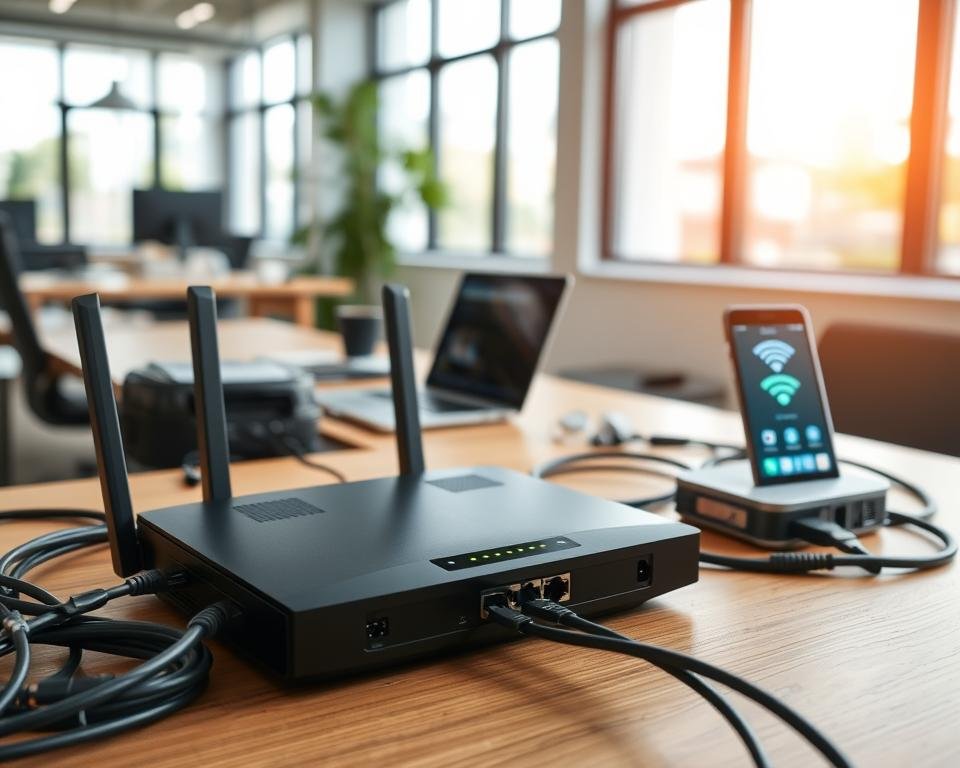
Wi-Fi Solutions for Small Offices
A strong Wi-Fi network is a must for small offices. It lets my team work well, whether they’re sitting or moving around. A reliable Wi-Fi is key for all the devices and tools my team uses every day.
When picking a Wi-Fi solution, I look for strong coverage and easy management. Top choices include mesh network systems and cloud-managed Wi-Fi. These offer seamless coverage and are simple to set up and manage.
Communication Tools I Can’t Live Without
Good communication is essential for any business. The right tools have greatly improved how my team works together and talks to customers. From VoIP phones to video conferencing, there are many options to boost communication.
I use VoIP phones for clear and affordable calls. Video conferencing tools are also crucial for remote meetings and team work. They save time and help build strong relationships with my team and clients.
By choosing the best gear for small business owners, like advanced networking and communication tools, I keep my business competitive and connected in today’s fast world.
Productivity Gear to Keep Me Focused
My quest for better efficiency begins with the right tools. As a small business owner, I know how vital it is to stay focused and manage my time well. The right gear can greatly help me reach my goals.
Time Management Apps I Swear By
Time management is key for small businesses. I’ve discovered several apps that have boosted my productivity. Here are some of my favorites:
- Trello: For organizing tasks and projects into boards.
- RescueTime: For tracking how I spend my time on my computer or mobile device.
- Focus@Will: For music that helps me concentrate.
These apps are now a big part of my daily routine. They help me stay focused and avoid distractions.
Collaboration Tools for My Team
Collaboration is essential for team success. I’ve found several tools that improve communication and teamwork. Some of these tools include:
| Tool | Purpose | Benefits |
|---|---|---|
| Slack | Team Communication | Real-time messaging, file sharing, and integrations with other tools. |
| Asana | Task Management | Assign tasks, track progress, and set deadlines. |
| Google Workspace | Document Collaboration | Collaborative document editing and storage. |
These tools have made our workflow smoother. They help us work together more efficiently.
Using these productivity tools has greatly improved my focus and time management. Whether it’s apps for time management or tools for teamwork, the right gear is crucial for small businesses aiming to increase productivity.
Inventory Management Systems
For small businesses with physical products, the right inventory management system is crucial. It helps cut down waste, boosts efficiency, and increases profits.
Managing my own business has taught me the value of the right tools. This includes technology and practices that keep my inventory in check.
Software I Use for Inventory Control
Many inventory management software options are available, meeting various business needs. Some top choices include:
- TradeGecko: Known for its ease of use and comprehensive features.
- Zoho Inventory: Offers robust inventory tracking and management capabilities.
- Skubana: Provides an all-in-one platform for inventory management, shipping, and more.
When picking inventory management software, consider scalability, user interface, and integration with current systems.
Best Practices for Keeping Track of Stock
Using the right practices is as important as the software. Here are some effective methods I’ve found:
- Regular Audits: Regular inventory audits help spot discrepancies and ensure accuracy.
- First-In-First-Out (FIFO): Using a FIFO system helps sell or use older stock first, reducing waste.
- Just-In-Time (JIT) Inventory: A JIT system minimizes storage costs and waste by ordering stock just in time.
By using the right software and these practices, small businesses can greatly improve efficiency and cut inventory costs.
Customer Relationship Management (CRM)
Understanding and using CRM is key for small businesses to grow. It helps in getting more customers and keeping them loyal. As a small business owner, it’s vital to manage customer relationships well.
CRM uses technology to manage sales, marketing, and customer service. It helps me understand my customers better. This way, I can personalize my interactions and grow my business.
My Favorite CRM Tools for Small Businesses
There are many CRM tools out there, each with its own strengths. Here are some of my top picks:
- HubSpot CRM: Easy to use and integrates well with other HubSpot tools.
- Zoho CRM: Offers lots of customization and scales well.
- Salesforce CRM: Has everything for sales, marketing, and customer service.
When picking a CRM tool, think about ease of use, scalability, and how well it fits with your systems.
| CRM Tool | Key Features | Pricing |
|---|---|---|
| HubSpot CRM | Contact management, sales pipeline tracking, email integration | Free – $50/user/month |
| Zoho CRM | Customization options, sales forecasting, lead management | $12/user/month – $45/user/month |
| Salesforce CRM | Comprehensive sales, marketing, and customer service solutions | $25/user/month – $300/user/month |
Benefits of Using CRM in My Daily Operations
CRM has made my daily work better. Here are the main benefits I’ve seen:
- Improved Customer Satisfaction: I can now personalize and quickly respond to customer questions.
- Increased Efficiency: I automate tasks and have all customer info in one place.
- Enhanced Sales Performance: I manage my sales pipeline better and forecast more accurately.

Using the right CRM tools and strategies helps small businesses. It improves customer relationships, drives growth, and keeps them competitive.
Shipping and Delivery Solutions
As a small business owner, I’ve learned that good shipping and delivery are key. They keep customers happy and help manage costs. The right shipping plans can really boost my business’s success and keep customers coming back.
To make shipping easier, I’ve picked a few services that simplify my shipping process. These include:
Services That Simplify My Shipping Process
- USPS: Known for their reliability and wide range of shipping options.
- UPS: Offers flexible shipping solutions and excellent tracking capabilities.
- FedEx: Provides fast and secure delivery options, ideal for time-sensitive packages.
These services help make sure my products get to customers on time and in great shape. They also give me tools to track and manage my shipments well.
Packaging Gear to Protect My Products
Along with shipping services, the right packaging gear is crucial for keeping products safe. I’ve found these packaging solutions to work well:
- Bubble mailers for secure and lightweight shipping.
- Sturdy boxes that can withstand shipping challenges.
- Packaging tape and fillers to prevent damage during transit.
By using reliable shipping services and the right packaging, I’ve cut down on losses. This has also made my customers happier. It’s been a big help for my small business, letting me grow while making sure products are delivered well.
Cybersecurity Tools for Protection
In today’s world, cybersecurity is a must for small businesses. With new tech comes new threats. It’s vital to use the right tools and practices to stay safe.
Protecting my business from hackers is key. But it’s also about keeping my customers’ data safe. A breach can hurt my finances and reputation. So, strong cybersecurity is a must.
Antivirus Software I Rely On
Antivirus software is a core part of my security plan. I choose top antivirus programs for their strong protection against malware and viruses. I look for features like real-time scanning and automatic updates.
Norton Antivirus and McAfee are my go-to choices. They keep my systems safe and detect new threats early.
“The average cost of a data breach is $3.86 million, making cybersecurity a critical investment for businesses of all sizes.”
Best Practices for Keeping My Business Safe
Having the right tools is important, but following best practices is just as crucial. Here’s how I keep my business safe:
- Regularly update all software and systems to ensure they have the latest security patches.
- Use strong, unique passwords for all accounts, and enable two-factor authentication whenever possible.
- Educate my team about cybersecurity best practices and the importance of being vigilant online.
- Conduct regular backups of critical data to prevent losses in case of a breach or system failure.
By using antivirus software and following best practices, I lower my risk of cyber threats. As cybersecurity evolves, I stay informed and adapt my strategies to keep my business safe online.
As my business grows, I keep using the latest small business technology solutions and top small business tools for protection. Cybersecurity is an ongoing effort, and I’m committed to staying ahead.
Continuous Learning and Development Gear
As a small business owner, I know how key learning and growth are. The right tools can make a big difference. I’m excited to share my top picks that have boosted my business.
Online Courses for Growth
Check out online courses on sites like Coursera, LinkedIn Learning, or Udemy. They offer great tools for small businesses at affordable prices. You’ll find courses on marketing, finance, productivity, and leadership.
Inspiring Business Books
Reading books is also a great way to learn and stay inspired. Favorites of mine include “The Lean Startup” by Eric Ries and “The 4-Hour Work Week” by Timothy Ferriss. They give valuable tips on starting and growing a business.
Using these learning tools, small businesses can stay ahead and succeed in the long run.