

Did you know that nearly 90% of a person’s first impression of a design depends solely on visual balance? I have found that simple shapes control how people feel about a brand almost instantly. Using basic circles or lines can change the entire mood of my projects in a second.
I find that geometric composition helps me bring a sense of order to any messy creative project. By using clear and structured patterns, I can create layouts that look very professional and clean. It is all about finding the right balance between simple forms and small details.
When I use these rules, my work naturally gains those sleek modern aesthetics that stand out today. I want to guide you through these core steps to help your own creative work shine. Let’s look at how these shapes can make your designs much more effective and memorable.
Key Takeaways
- Discover how shapes influence the first impression of a viewer.
- Learn to create visual balance using very simple layouts.
- Identify the secret to achieving clean modern aesthetics in any project.
- Explore why structured patterns make a design look more professional.
- Master the use of basic elements to organize complex information.
- Understand the emotional impact of different shapes on your audience.
Understanding the Basics of Geometric Composition
The heart of a great design is its geometric composition. It’s about arranging visual parts thoughtfully. To really get it, we need to look at what makes up this composition.
What is Geometric Composition?
Geometric composition uses shapes like triangles, circles, and squares to make designs look good. These shapes help achieve balance, harmony, and contrast. Knowing how to use them well lets designers make beautiful and structured designs.
Key Elements of Geometric Design
Geometric design is built on shapes, lines, and visual organization. These parts work together to make a design that grabs your attention. Let’s dive into each:
| Element | Description | Example Use |
|---|---|---|
| Geometric Shapes | Basic shapes like triangles, squares, and circles used to form the composition. | Using a triangle to create a focal point. |
| Lines | Lines that guide the viewer’s eye through the composition. | Employing a diagonal line to create movement. |
| Visual Organization | Principles that dictate how elements are arranged to achieve balance and harmony. | Applying symmetry to create a sense of order. |
By learning these elements and how they work together, designers can make geometric designs that are eye-catching and clear in their message.
The Importance of Shapes in Design
Shapes in design are more than just pretty pictures. They help create a structured design that sends a message. Shapes are the base of geometric designs, and knowing their role is key to good design.
Shapes can make us feel certain ways and mean different things. Circles often mean unity and completeness. Triangles can show strength and stability. Designers use these meanings to connect with their audience.
The Power of Basic Shapes
Basic shapes like squares, circles, and triangles are the geometric elements that start more complex designs. Each shape has its own special qualities. They help designers achieve different looks in their work.
Squares and rectangles bring a feeling of stability and order. Circles add softness and flow. Triangles bring energy and tension.
Combining Shapes for Impact
Designers mix basic shapes to make interesting and complex designs. They use layering, rotation, or size changes to add depth. This makes their designs stand out.
The trick is to mix shapes in a way that looks good and grabs attention. This means using different shapes, sizes, and angles. It’s all about creating a dynamic look that draws the viewer in.
For example, mixing a circle with a triangle can make a design feel lively. Pairing a square with a rectangle can make it feel solid and structured. The right mix can turn a simple design into something amazing.
Color Theory in Geometric Composition
Using color theory can make geometric compositions more engaging. It shows how color affects the look and feel of abstract geometry and mathematical patterns. The right colors can make shapes stand out or blend in smoothly.
Color helps create contrast, harmony, and balance in designs. By knowing how colors work with shapes, designers can make their work both beautiful and touching.
How Color Affects Geometry
Colors change how we see geometric shapes. Warm colors like red and orange make shapes seem closer. Cool colors like blue and green add depth. This is key for creating visual interest and hierarchy in a piece.
Contrast is also important. Different colors can create tension or harmony. For example, a bright color against a soft background can highlight certain shapes.
Choosing a Color Palette
Picking the right color palette is essential. It’s about matching colors with the geometric shapes to create a unified design. A good palette can make the whole piece more impactful.
When picking colors, think about these things:
| Factor | Description | Example |
|---|---|---|
| Color Harmony | Using principles like complementary, analogous, and triadic color schemes helps choose colors. | Using blue and orange for contrast. |
| Emotional Impact | Different colors evoke different feelings; red is energetic, blue is calming. | Using red to highlight a pattern. |
| Cultural Considerations | Colors mean different things in different cultures; it’s important to know this for good design. | Avoiding white in designs for cultures where it’s a color of mourning. |
By thinking about these points and using color theory, designers can make geometric compositions that are not just pretty but also meaningful and emotionally engaging.
Creating Balance in Your Designs
Balance is key to a design’s success. It makes a design look stable and appealing. In exploring geometric composition, balance is a critical element achieved through various techniques.
There are two main types of balance: symmetrical and asymmetrical. Symmetry means parts are exactly the same on both sides. Asymmetry, on the other hand, balances without symmetry, using different elements.
Symmetry vs. Asymmetry
Symmetrical balance brings order and stability, often seen in traditional designs. Asymmetrical balance, used in modern designs, creates a dynamic feel. Knowing when to use each is important.
Symmetry is common in architecture for its formal look. Asymmetry is popular in graphic design for its engaging feel.
| Balance Type | Characteristics | Common Use |
|---|---|---|
| Symmetrical | Orderly, stable, formal | Traditional designs, architecture |
| Asymmetrical | Dynamic, interesting, creative | Modern designs, graphic design |
Visual Weight and Its Impact
Visual weight is how elements feel in a design. It’s based on size, color, and placement. Understanding visual weight helps achieve balance.
A large, dark shape has more visual weight than a small, light one. Designers use visual weight to balance compositions and guide the viewer’s eye.
Designers use symmetry, asymmetry, and visual weight to create balanced compositions. This balance engages the viewer and conveys the message.
Utilizing Space Effectively
Space is key in geometric composition, shaping how elements interact and look. Using space well can make a design go from simple to stunning.
Positive vs. Negative Space
Knowing the difference between positive and negative space is key for balanced designs. Positive space is where elements are, and negative space is the empty areas around them.
A good design uses both spaces well. Negative space can make a design simple and clean. Positive space can highlight certain parts.
Creating Depth in Your Design
To add depth to a design, you can use several methods. These include overlapping elements, changing sizes, and playing with colors.
Here’s a quick guide to adding depth:
| Technique | Description | Effect |
|---|---|---|
| Overlapping | Placing elements on top of each other | Creates a sense of layering |
| Size Variation | Varying the size of elements | Creates a sense of distance |
| Color Manipulation | Using colors to create contrast | Draws attention and creates depth |
By using these methods, designers can make designs that are not only beautiful but also guide the viewer’s eye. This improves the overall visual organization.
Exploring Patterns in Geometry
Patterns are key in geometric composition, making designs more engaging. They add texture and interest, taking a simple design to the next level. In geometric design, patterns help create rhythm and harmony.
Mathematical patterns and geometric art often go hand in hand. Designers use math to create unique and captivating designs.
Types of Patterns to Consider
There are many types of patterns for geometric designs. Some common ones include:
- Geometric patterns that repeat shapes in a specific order, creating a sense of continuity and flow.
- Mosaic patterns, which involve small, repeated elements that form a larger image or design.
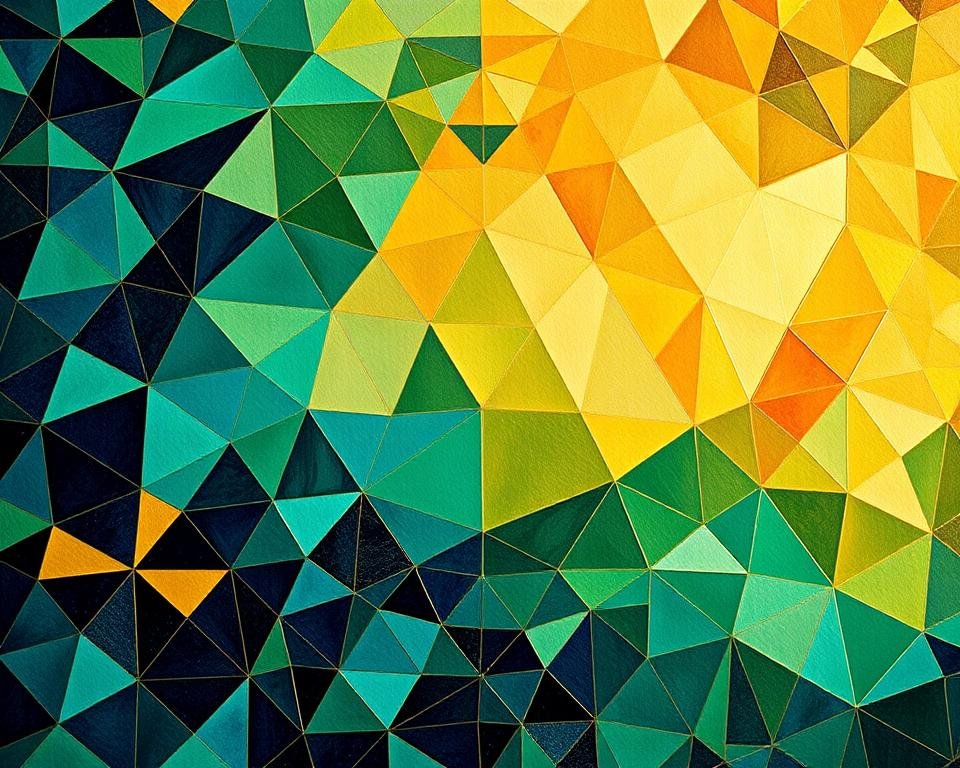
- Tessellations, where shapes are fitted together without overlapping to create a seamless pattern.
The Role of Repetition
Repetition is vital in creating effective patterns. It helps achieve unity and coherence in designs. It also guides the viewer’s eye, creating movement and flow.
But, too much repetition can be boring. Adding variations in size, color, or orientation makes patterns more interesting.
In summary, patterns are a powerful tool in geometric composition. They offer many creative possibilities. By understanding different patterns and the importance of repetition, designers can create designs that grab attention.
The Role of Lines in Compositions
In the world of geometric composition, lines are key. They shape the visual story. Lines create shape, define edges, and guide the viewer’s eye.
Lines are more than basic elements. They are the core of complex and engaging designs. By using different lines, designers can add depth, texture, and emotion.
Different Types of Lines
There are many types of lines in geometric composition. Each has its own look and effect. These include straight, curved, diagonal, and zigzag lines.
| Type of Line | Description | Effect on Composition |
|---|---|---|
| Straight Lines | Lines that move in a constant direction | Create a sense of order and stability |
| Curved Lines | Lines that change direction in a smooth, continuous motion | Add a touch of elegance and fluidity |
| Diagonal Lines | Lines that run at an angle relative to the composition’s frame | Introduce dynamism and energy |
| Zigzag Lines | Lines that consist of a series of alternating angles | Create a sense of tension and excitement |
Using Lines for Movement and Flow
Lines help create movement and flow in a design. They guide the viewer’s eye. By choosing and placing lines wisely, designers can engage the viewer.
Diagonal lines add energy and movement. Curved lines guide the eye smoothly. To learn more, visit Mastering the Art of Lines in Photography.
Designers who master lines in geometric composition create stunning designs. These designs grab attention and convey messages effectively.
Tools and Software for Geometric Design
Exploring geometric design, I see that the right tools are key for amazing visuals. Thanks to tech, many digital tools and software help create geometric designs.
The best software can greatly improve your design’s quality and detail. Popular choices for geometric design include Adobe Illustrator and Photoshop. They have many features for working with geometric shapes.
Recommended Design Software
Adobe Illustrator is a top pick for geometric design. It’s great for making detailed patterns and shapes.
- Adobe Illustrator
- Photoshop
- Other vector graphics editors
Tips for Using Digital Tools
To use design software well, learn its tools and features. Trying out different methods and shortcuts can really help your design work.

Mastering digital tools lets you make geometric designs that are eye-catching. They also show off your unique style and creativity.
Real-Life Applications of Geometric Composition
Geometric composition is everywhere in our world. It’s in the buildings we see every day and the designs on our clothes. It even shapes the way we use technology.
Think about the architecture of cities. Buildings like the Guggenheim Museum in New York use geometric shapes to create stunning designs. These shapes help guide people through the space and add beauty to the cityscape.
Designers also use geometric composition in fashion. Look at the patterns on your favorite clothes. They often use shapes and lines to create eye-catching designs. These patterns can make a simple outfit stand out.
Even technology is influenced by geometric composition. The layout of your phone’s interface is designed using geometric shapes. These shapes help you navigate and find what you need quickly.
Geometric composition is all around us. It’s in the buildings, the clothes we wear, and even our technology. It helps create visually appealing designs and makes our world more interesting.
Tips for Developing Your Style
In the world of geometric design, finding your personal style is a journey. It’s about trying new things and learning as you go. Developing a unique style helps you stand out.
Understanding the basics of geometric composition is key. Then, use these principles to show your own style. This means exploring shapes, colors, and patterns to improve visual organization.
Finding Your Unique Voice
Finding your unique voice in geometric design is a process. It involves trying different things and learning from mistakes.
One way to find your voice is by experimenting with different techniques and tools. Try various software or create patterns by hand. This helps you find what works best for you, leading to a more structured design.
Experimenting with Different Techniques
Experimentation is vital for developing your style. Trying new techniques lets you express your creativity and show your unique perspective.
For example, you might mix different shapes or colors to create a striking composition. Be open to new ideas and willing to take risks. Always keep structured design principles in mind.
| Design Element | Effect on Visual Organization | Example Use |
|---|---|---|
| Shapes | Provides structure and form | Using triangles to create a sense of balance |
| Colors | Evokes emotions and conveys meaning | Utilizing a bold color palette to draw attention |
| Patterns | Adds texture and interest | Incorporating geometric patterns to enhance visual appeal |
In conclusion, developing your style in geometric composition is a journey. It takes patience, creativity, and a willingness to experiment. By finding your unique voice and exploring different techniques, you can create stunning and meaningful designs. These designs will show off effective visual organization.
Case Studies in Geometric Composition
Looking at successful designs helps us grasp the basics of geometric composition. By studying case studies, we learn how to use mathematical patterns to make designs that look good and work well.
Successful Designs in Practice
Effective designs use geometric composition in smart ways. For example, symmetry and asymmetry can add balance or create tension. This is seen in everything from buildings to clothes.
Lessons from Design Mistakes
Mistakes teach us a lot in design. By seeing what went wrong, we can get better at using geometric composition. This means figuring out how to use mathematical patterns to make designs better.
Case studies help us understand and improve our skills in geometric composition. We learn how to create designs that are both visually appealing and effective.